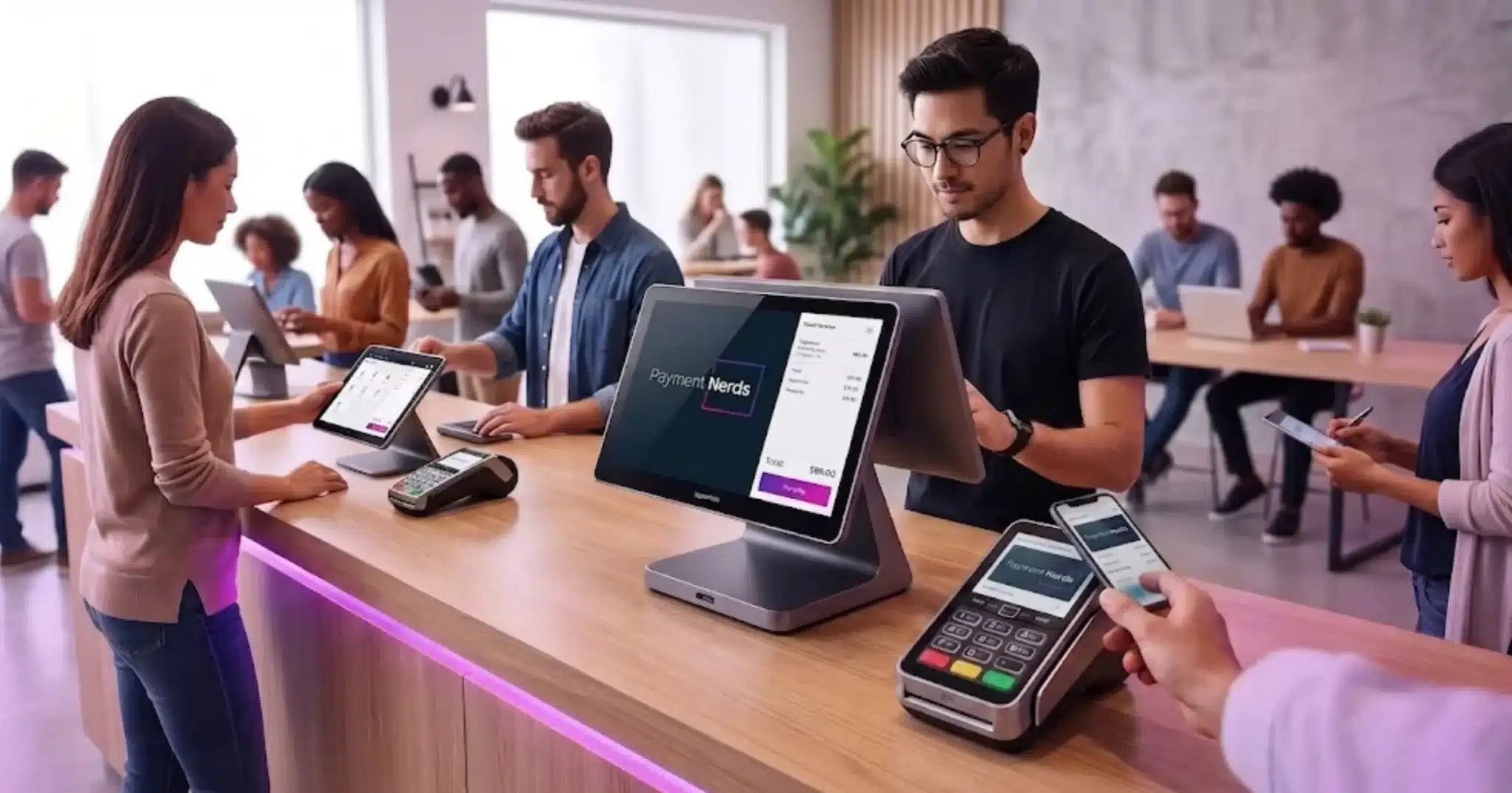



Square lets eligible businesses download its app and start accepting card payments without having to negotiate a merchant account proposal with the company. This makes Square very attractive to different types of small businesses, including retail stores, restaurants, mobile businesses, and service industries.
However, another company named Payment Nerds fills a different need. Payment Nerds allows businesses to compare merchant accounts and payment solutions according to their industry. If a business is considering a Square alternative, the best solution may not be Square itself, but rather a merchant account solution that better fits the type of business they operate.
Square and Payment Nerds Use Different Account Models
Square operates as a payment facilitator. Its payment terms state that Square is not a bank and works with card networks, processors, and acquiring banks to let sellers accept payments. Merchants are onboarded within Square’s larger payment environment rather than negotiating an individual acquiring relationship at the beginning.
Payment Nerds takes a consultative merchant-services approach. Eligible businesses can be matched with merchant accounts, processors, gateways and payment tools based on their industries, sales channels, volume, tickets and risk exposure. Payment Nerds primarily works with gateways such as Authorize.net and NMI while also supporting ACH, virtual terminals, POS integrations and ecommerce workflows.
These models create different experiences:
| Account Factor | Square | Payment Nerds |
|---|---|---|
| Account structure | Payment facilitator | Separately underwritten merchant-account options |
| Onboarding | Primarily self-service and standardized | Document-based and consultative |
| Pricing | Published rates and software plans | Customized by processor and underwriting |
| Best fit | Supported small businesses seeking integrated tools | Standard, specialized or high-risk merchants needing account guidance |
| Gateway | Square’s payment ecosystem | Options may include NMI and Authorize.net |
| ACH | Available through eligible Square workflows | May be incorporated into a broader card and ACH strategy |
| Risk review | May continue after onboarding | Business model is reviewed before final approval |
| Reserve | May be added when Square identifies risk | May be disclosed as part of underwriting |
| Support model | Plan-based Square support | Account and processor-fit guidance |
| Industry eligibility | Governed by Square’s unsupported-business policies | Depends on acquiring-bank and processor underwriting |
Neither structure is automatically superior. Square reduces setup complexity when the business fits its rules. Payment Nerds provides more account-selection flexibility when the merchant’s products or transactions require deeper review.
Is Square or Payment Nerds Right for Your Business?
Square is generally the stronger fit for a business that is:
- operates in a supported category
- needs a POS and payment system
- takes in-person and mobile payments only
- values published flat-rate pricing
- prefers self-service setup
- does not need a separate payment gateway
- has predictable sales volume and ticket sizes
- is comfortable with Square’s hardware and software
Payment Nerds may be the stronger fit for a business that is:
- sells regulated products
- was declined or terminated by Square
- takes high-ticket or future-delivery goods
- relies upon subscriptions and card-not-present sales
- needs a high-risk merchant account
- requires NMI or Authorize.net compatibility
- needs to process ACH payments
- needs greater control over available payment gateways and limits
- wants to compare payment gateway and processor options
- experiences high levels of fraud and chargebacks
The eligibility requirements for each of these companies should be the starting point in selecting a payment provider for a business. A low processing rate is irrelevant for a payment provider that does not support the type of products or sales volume of a merchant.
How Square Fees Work in 2026
Current Square fees depend on the software plan and transaction channel. Square Free has no monthly per-location subscription, while Square Plus costs $49 per month per location and Square Premium costs $149.
| Square Payment Type | Free | Plus | Premium |
| In-person tap, dip or swipe | 2.6% + 15¢ | 2.5% + 15¢ | 2.4% + 15¢ |
| Online or invoice card payment | 3.3% + 30¢ | 2.9% + 30¢ | 2.9% + 30¢ |
| Online API payment | 2.9% + 30¢ | 2.9% + 30¢ | 2.9% + 30¢ |
| Manual entry or card on file | 3.5% + 15¢ | 3.5% + 15¢ | 3.5% + 15¢ |
| Monthly plan per location | $0 | $49 | $149 |
Square also offers ACH bank transfers through invoices and APIs, with pricing, minimum charges and fee caps varying by plan and integration. Additional charges may apply for Afterpay, marketing tools, gift-card loads, kiosk software and other optional services.
Square does not currently charge sellers an additional fee for its dispute-management service. However, disputed funds may still be debited or held while the case is reviewed, and the merchant remains responsible for chargebacks it loses.
Payment Nerds Pricing vs. Square
Payment Nerds does not use one published transaction rate for every merchant. Pricing depends on the acquiring bank, processor, industry, monthly volume, average ticket, payment channels, chargeback history, and underwriting outcome.
A proposal may cover:
- interchange or wholesale card costs
- processor markup
- per-transaction charges
- monthly account fees
- gateway fees
- ACH fees
- PCI-related fees
- chargeback fees
- fraud-tool fees
- equipment or software costs
- monthly minimums
- reserve requirements
- contract or termination stipulations
Customized pricing may make for more complex comparisons than Square’s simple published rates. However, it can also mean the proposal reflects the merchant’s actual mix of cards, transaction sizes and levels of risk rather than applying a blended rate to every business.
The most valuable comparison is an effective-rate analysis using recent statements. Merchants should determine total processing-related cost as a percentage of card volume and compare reserves, funding and software costs separately.
Square Fees vs. Payment Nerds: Which Costs Less?
For small businesses, Square’s Free plan can eliminate the cost of a POS subscription, which helps businesses estimate monthly costs.
As a business grows, a custom merchant-account proposal might prove more competitive. If a business has a good mix of debit and low-cost cards, the interchange-plus rates might be better than the flat rate that Square uses.
High-risk merchants will see higher rates with Payment Nerds than with Square. The high-risk merchant account fees and charges reflect the extra exposure that the merchant account company is taking in accepting high-risk merchants. These terms can be compared with the cost of using a merchant account that does not suit the business.
The lowest rate will not always be the least cost-effective for a business. A business could experience a shutdown, frozen funds, software that is not compatible with what the business uses, and the cost of migrating payments software can add up to more than the small difference in the cost of the transaction rate.
Square’s Business Restrictions Matter
Square’s terms of service exclude businesses that engage in activities such as credit counseling or credit repair, direct marketing, telemarketing, betting, adult-oriented products, firearms, age-restricted products, and other high-risk products and services. Merchants should review the complete current terms of service for Square, not just the summary of excluded services.
A business may change after opening an account with Square. For instance, adding subscriptions to a business, offering online sales of merchandise, or changing the ticket price for merchandise can all change the type of business and its risks.
Square can also defer the release of proceeds from sales to merchants that are investigating disputes, fraud, or other risks to the company.
Square can also change the size of a reserve for merchants based on their payment history and any other risks to the company using Square.
This doesn’t make Square appropriate for every type of business; however, it does make Square a consideration for entrepreneurs to consider as an operating requirement for their business.
When Payment Nerds Is a Better Square Alternative
Payment Nerds can be a decent Square alternative for merchants who need individual underwriting or don’t fit into Square’s model of approved businesses.
This might apply to qualifying merchants who have:
- regulated product categories
- high chargeback risk
- high-ticket items
- subscriptions and recurring billing
- services delivered in the future
- history of terminating processors
- international sales
- MOTO or virtual terminal payments
- complex ecommerce set ups
- multiple payment channels
- ACH and card needs
- dependencies on NMI or Authorize.net software
The application may be more complex. Underwriters may ask for documentation of ownership, bank statements, processing history, licenses, refund policies, fulfillment and chargeback processes.
That extra work can lead to more stability when the account is approved for the merchant’s true business model. Approval, rates, reserves, and funding cannot be promised, however.
POS Hardware and Business Software
Square’s strongest advantage is its connected commerce ecosystem. The company offers readers, handheld devices, countertop registers, inventory, invoices, appointment and restaurant software, as well as online ordering and employee management features.
These different software solutions can reduce the work for implementing a payment system for a retail account. Retailers can purchase Square hardware, use Square software, and all transactions will appear on the same account and dashboard.
While Payment Nerds does not seek to replace Square with a universal POS application, the platform allows merchants to select the best payment terminal, POS, and gateway applications according to their accounts’ requirements. This approach is especially helpful for merchants that need specialized retail software.
However, there is a degree of complexity to integrating these programs. Merchants will have to ensure that the POS application, device, gateway, processor, and bank are all compatible with one another.
Payment Gateways, Ecommerce & Recurring Billing
Square offers online checkout, invoices, payment links, APIs, and more within its own platform. This is suitable for businesses that want to remain within the Square platform alone.
Payment Nerds can be more suitable for merchants that require a separately approved gateway. NMI and Authorize.net can perform ecommerce functions, recurring billing, virtual terminals, payment links, and more through a merchant’s account.
A separately managed gateway can give the merchant more flexibility with their processing company. The merchant can potentially change their processor without having to rebuild their checkout functions (though this will depend upon the tokenization and integration agreements between the two companies).
Reserves, Funding & Account Stability
Square can impose a reserve if it deems some aspect of the business particularly risky. Its documentation mentions advance payment for goods or services as one reason Square may decide to impose a reserve while it assesses the seller’s refund and chargeback behavior.
Square’s terms also allow for payout delays, reserves, new fees, and suspension or termination if the company believes a seller has or may have excessive chargebacks.
A high-risk account with Payment Nerds might also be subject to a rolling reserve or funding delay. The difference is that these terms may be set at underwriting rather than applied after the fact.
Merchants should look at:
- reserve percentage
- holding period
- payout schedule for released funds
- payout schedule for all funds
- maximum ticket size
- volume limits
- chargeback limits
- terms for changes to the above
- treatment of funds after termination
An announced reserve can still create pressure on cash flow. The upside is predictability rather than the absence of controls.
Chargebacks and Visa Acquirer Monitoring Program Risk
While Square may limit an account associated with a merchant that has too many chargebacks, that same merchant is still responsible for preventing fraud and maintaining reasonable dispute performance with Square. If the merchant is underwritten by a separate processor from Square, that processor can also limit the merchant’s account.
Visa’s Acquirer Monitoring Program (VAMP) combines the network’s fraud and non-fraud chargebacks with the settled card-not-present Visa transactions. High-risk merchants should focus on their TC40 fraud reports, TC15 disputes, authorization and enumeration attacks, not the chargebacks that they have to monitor.
Payment Nerds provides high-risk merchants with services that aim to provide greater control of their accounts with the processor with which they work. While these services may help merchants to detect and rectify problems with their accounts early in their development, they do not assure merchants that they will remain below the thresholds of their processor or card networks.
When Square Is the Better Choice
Square is the likely better option if the merchant:
- fits Square’s policies
- wants to start accepting payments quickly
- sells in person only
- needs a straightforward POS
- wants to stick to published flat rates
- does not mind the lack of integration with other systems
- has relatively modest sales volumes
- prefers having one software and payment dashboard only
- does not require a separately controlled merchant account gateway
A café, boutique, salon, food truck or other service provider that does not require the advanced merchant account controls that Square offers may find little value in the additional options and tools that the company offers.
When Payment Nerds Is the Better Choice
Payment Nerds is more likely to fit when the merchant:
- cannot obtain or retain Square approval
- operates in an eligible high-risk category
- needs deeper underwriting
- wants customized account limits
- requires ACH for larger transactions
- uses high-ticket or future-delivery billing
- needs recurring or MOTO payments
- requires NMI or Authorize.net
- wants to compare multiple acquiring options
- needs additional account and risk guidance
A merchant should not move merely because one provider advertises a lower rate. The new structure must improve industry fit, payment capabilities or long-term stability.
How to Switch From Square
Do not close your Square account until the new company has approved and tested the new processor.
To switch Square accounts, follow these steps:
- Download your statements
- Understand why your account was restricted
- Calculate your ticket and volume
- List all your products and channels
- Collect your bank and business records
- Get approval for your merchant account
- Ensure your POS systems are compatible
- Test your POS systems
- Plan for stored cards
- Update your billing descriptors
- Keep access to your records
- Move your transactions
Business owners who wish to switch merchants should not create a new company or change their description on the platform to hide their reason for the previous restriction. This gives the new company a better idea of the terms under which they will operate your merchant account.
Payment Nerds and Square Comparison Mistakes
The most common mistake is to compare Square’s published rate with only one line from a custom merchant-account proposal.
Other common mistakes include:
- choosing Square without reviewing which industries they don’t support
- assuming that a fast setup means they’ll approve your account over time
- failing to compare fees without considering the cost of the software
- failing to read their reserve and funding terms
- failing to review their online and manual entry rates
- treating Payment Nerds as if it’s only one payment processor
- assuming that because a company offers specialized underwriting for merchants, they’ll approve your account
- buying payment hardware before determining that you’re eligible for an account
- failing to disclose all subscriptions and high ticket numbers to them
- changing payment processors without first testing refunds
- closing your Square account before the new payment processor’s account is live
- choosing only a payment processor based on its transaction rate
When you compare payment processors, you should consider each company’s eligibility, account structure, software options, and total cost and risk of operating with that company.
Payment Nerds vs. Square Questions
Q: Is Payment Nerds cheaper than Square?
A: It depends on a few different factors about the merchant and their cards. While Square can publish the rate it will charge merchants for payments, Payment Nerds allows merchants to compare proposals from individual companies.
Q: What are Square’s current processing fees?
A: Square Free offers two main rates for merchants. For in-person payments, they charge 2.6% plus 15 cents. For online payments, they charge 3.3% plus 30 cents. Each of these plans may have different rates, however.
Q: Is Square good for high-risk businesses?
A: Square may not be the best company for those in high-risk businesses. Many of the businesses that Square supports are not high-risk themselves, and do not offer the same types of businesses or industries for merchants to use their services.
Q: What is the best Square alternative for high-risk merchants?
A: The best Square alternative is a company that offers the services required by your current industry, sales volume, sales value, and accepted payment methods. Payment Nerds can help high-risk merchants compare merchant accounts, payment gateways, ACH, and POS software.
Q: Does Payment Nerds offer POS systems?
A: While Payment Nerds does not offer POS systems directly, they can help merchants compare POS systems and payment processors with similar features and price ranges.
Q: Can Payment Nerds help after Square closes an account?
A: Yes, if you are a high-risk merchant with an active Square account, Payment Nerds can assist with opening a new merchant account. You will have to provide information regarding your closed Square account during the merchant application process.
Q: Does Square charge chargeback fees?
A: Square does not charge any fees for its dispute-management service. However, merchants are responsible for the lost funds from disputed chargebacks.
Q: Does Payment Nerds require a reserve?
A: Not every merchant account will require a reserve. The requirements will depend on the business category, the financial condition of the company, how they fulfill their orders, and their potential chargebacks.
Q: Can I use Square and another merchant account?
A: Depending on the business, there are situations where more than one merchant account can be used. However, each business must use the merchant account that supports the specific business activity.
Choose the Processor That Fits the Business
Square offers a strong selection of payment processing solutions for small and supported businesses looking for a complete POS solution that includes published rates and more. If the business requires underwriting, high-risk accounts, ACH or needs to move away from Square payment processing, then Payment Nerds may be a better option. The key is to find the best processor for your business based on Square fees and other factors.
Sources
- Square. “Processing Fees, Plans and Software Pricing.” Accessed August 2026.
- Square. “Square Payment Terms.” Accessed August 2026.
- Square. “Manage Payment Reserves With Square.” Accessed August 2026.
- Square. “Manage Payment Disputes.” Accessed August 2026.
- Square. “POS Hardware and Equipment.” Accessed August 2026.
- Visa. “Visa Acquirer Monitoring Program Overview.” Accessed August 2026.