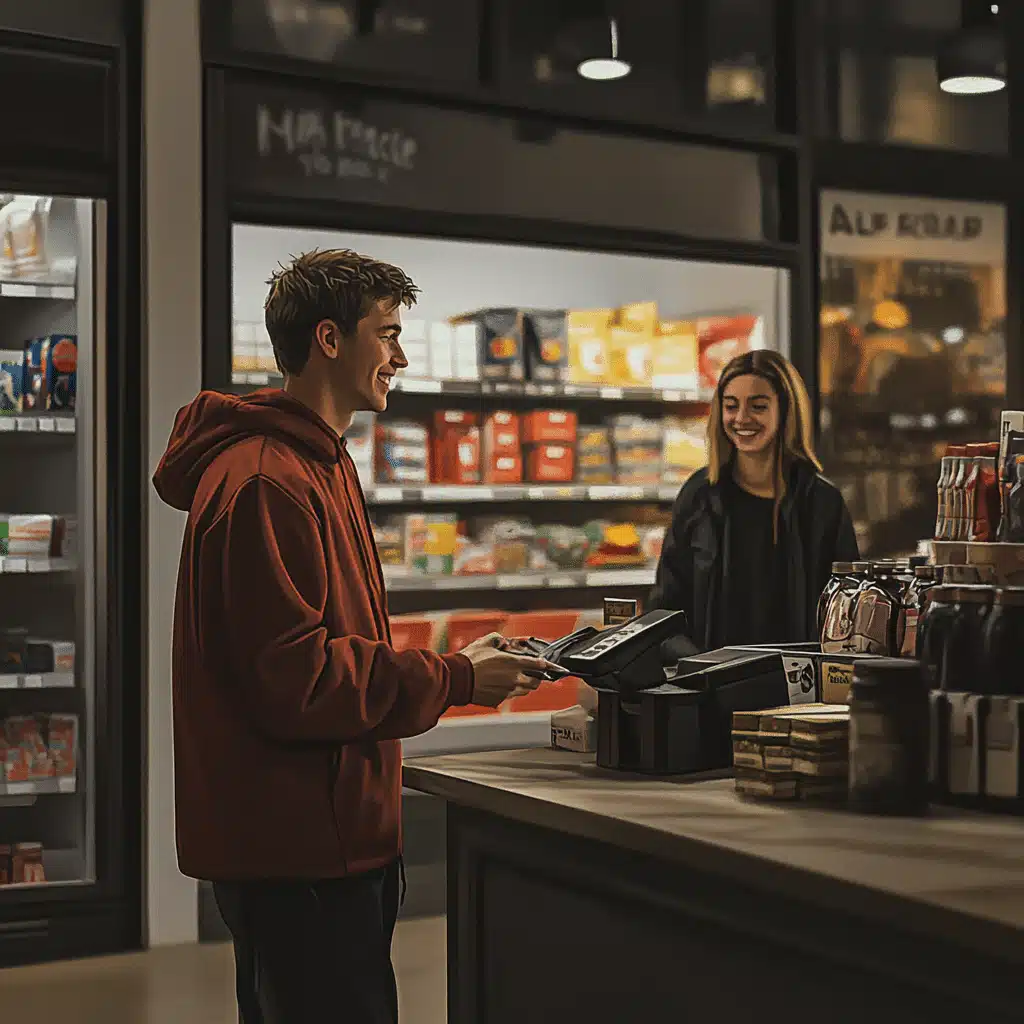



A convenience store POS system must manage sales of coffee, tobacco, lottery products, groceries, fuel (with prepays), and EBT products. Each transaction must happen quickly without creating separate sales records for each product category in the store.
When selecting a convenience store POS system, there are many features and functions to consider. Convenience stores that also sell motor fuel require a forecourt and fleet card system. Convenience stores that do not sell fuel products should consider features such as inventory control, age verification systems, food service sales, and the costs of convenience store credit card processing systems.
There are many convenience stores in the United States. According to the United States Department of Commerce, there are 151,975 convenience stores in the country, and 122,620 of them also sell motor fuel products. Convenience stores account for 80% of all motor fuel purchased by people in the United States.
What a Convenience Store POS System Should Handle
Whether or not fuel is sold has a major bearing on the features required of a POS system.
A gas station POS system can include features such as:
- pump authorizations
- fuel prepayments and refunds
- fleet cards
- fuel pricing software
- forecourt reconciliation software
- dispenser integration
Nonetheless, the internal convenience store may require features such as:
- barcode scanning
- fast EMV and contactless payment processing
- EBT and SNAP benefits
- split tender support
- age-restricted product selling software
- tobacco and alcohol selling software
- lottery software
- foodservice POS software
- loyalty programs
- inventory and pricebook software
- employee permissions software
- multi-location reporting
- offline functionality
SNAP acceptance requires separate retailer authorization and correctly configured EBT transaction services. USDA has also begun supporting chip-enabled EBT cards, with retailers instructed to attempt insert or tap first when both the card and POS support it.
Age-restricted products deserve similar attention. Federal tobacco rules prohibit sales to customers under 21 and require photo-ID verification for customers under 30 attempting to purchase tobacco products.
7 Best Convenience Store POS Systems for 2026
| POS System | Best Fit | Main Strength | Main Tradeoff |
|---|---|---|---|
| Verifone Commander + C18 | Fuel-selling c-stores | Deep forecourt, payment and store integration | Specialized ecosystem |
| Invenco Passport | Established fuel retailers | Fuel integration, uptime and broad partner ecosystem | More system than simple non-fuel stores need |
| Petrosoft SmartPOS | Independent c-stores | Inventory, EBT, lottery and processor choice | Full value depends on back-office configuration |
| NCR Voyix | Enterprise and multi-site operators | Fuel, retail, foodservice and enterprise scale | Greater implementation complexity |
| LS Central for Forecourt | Multi-service and expanding chains | Fuel, retail, foodservice and ERP in one platform | Better suited to more complex operators |
| Clover | Small non-fuel c-stores | Flexible hardware and straightforward retail tools | Not a complete forecourt platform |
| Square for Retail | New and simple non-fuel stores | Easy setup and age-restricted retail tools | Limited fit for complex petroleum operations |
1. Verifone Commander + C18: Best Overall for Fuel C-Stores
Verifone Commander was built specifically for convenience and petroleum sales.
The system links forecourt and store sales and payments. The C18 is the cashier display for the POS. The system handles fuel sales, store sales, payment processing, pump management, store and fuel reports, age verification and self-checkout.
Verifone says it operates at over 55,000 sites and 40% of U.S. convenience stores. Its electronic payments server allows convenience stores to link to payment processors, fleet networks and loyalty programs for fuel, store, app and online sales.
Best for: Fuel-selling convenience stores.
2. Invenco Passport: Best for Established Fuel Retailers
Passport is another purpose-built gas station POS system that features petroleum integrations.
The system is currently used at over 42,000 locations and integrates with over 120 different partners for functions like loyalty, back-office systems, signage and security. The system also features self-checkout and ordering capabilities for restaurants.
Passport can manage indoor and forecourt locations as well as fuel-specific sales functions. The self-checkout software also handles fuel and age-restricted sales with staff oversight.
Best for: Gas stations that require forecourt sales integration.
3. Petrosoft SmartPOS: Best for Independent Convenience Stores
Petrosoft SmartPOS was developed to handle convenience stores and offer back-office sales functions.
Current SmartPOS functionality includes support for EBT, age-controlled departments, lottery management, inventory, loyalty, and several payment methods. The company also offers flexibility in choosing the card processor for each merchant.
That kind of flexibility in choosing POS software and hardware is helpful for an independent operator who is also evaluating credit card processing companies for their convenience stores.
Petrosoft claims to support over 10,000 convenience and fuel stores.
Best for: Independent convenience stores seeking a strong pricebook and back-office component for their point-of-sale software.
4. NCR Voyix: Best for Enterprise Convenience and Fuel
NCR Voyix is geared toward larger convenience store operators seeking point-of-sale (POS) software that manages fuel, convenience, foodservice, and digital retail sales across multiple locations.
Its current convenience and fuel platform combines forecourt, in-store, and digital operations with self-checkout, loyalty, payments, and real-time operational reporting.
Pilot has partnered with NCR Voyix to modernize the Point of Sale (POS) systems at its more than 900 travel centers. The five-year project will begin in 2026. NCR Voyix’s fuel technology partners with over 18,000 fuel stations.
Best for: Large c-store chains, travel centers, and enterprise petroleum operators.
5. LS Central for Forecourt: Best for Multi-Service Operations
The software is especially useful for locations that include more than just fuel pumps.
The forecourt platform allows chains to manage fuel, convenience, retail, food, EV charging, and car wash stations. Functions include pump controls, prepay and post-pay fuel pumps, wet stock management, inventory management, loyalty management and multi-site central pricing.
Since the platform also integrates with a business’s ERP and finance functions, it can be a good fit for fuel retailers who want centralized control over their operations as they grow.
Best for: Fuel retailers who also offer c-store, foodservice, and other types of services.
6. Clover: Best for Smaller Non-Fuel C-Stores
Clover is a better platform for convenience stores that value having a retail store counter over fuel pump integration.
Clover’s convenience store platform allows retailers to manage inventory, track when products are about to run out of stock, manage multiple locations, create employee roles and permissions, implement loyalty programs, and accept offline payments.
Clover has also added support for age-restricted merchandise. Merchants can designate which merchandise categories require customers to be of a certain age to purchase. For example, categories for tobacco and alcohol products can have a minimum age requirement.
Clover’s merchant services may vary depending on the type of equipment purchased for the stores.
Best for: Small convenience stores that do not sell fuel.
7. Square for Retail: Best for New, Simple C-Stores
Square is another merchant service that is an accessible platform for small convenience stores.
In addition to accepting contactless payments, this system tracks inventory, verifies customers’ age through an optional birthdate entry or ID scan, collects bottle deposits, and generates sales reports online. Although Square does not offer the same features as gas stations, such as fuel inventory, fleet cards, and petroleum products, it is suitable for convenience stores that do not require them.
Best for: Small, new convenience stores that require no fuel features.
Compare Convenience Store Credit Card Processing and POS Costs
Convenience retailers process enormous transaction volumes with their stores.
Convenience stores in the U.S. processed an average of 45,160 transactions per location per month in 2025. They paid out $21.3 billion in fees for credit and debit card transactions.
Before signing a POS agreement, companies should compare the following:
- credit card markup
- PIN debit transactions
- fuel transaction pricing
- fleet card acceptance
- EBT services
- software monthly fees
- hardware costs
- equipment leasing
- PCI fees
- batch fees
- chargeback fees
- contract length
- early termination fees
- processor portability
The flexibility of the POS and the processing company differs. Some of the best fuel retailers have specific relationships with certified payment processors. Others may use a more general-purpose POS and payment system. Petrosoft allows fuel retailers to choose their payment processor. Payment Nerds can compare merchant account services for convenience and fuel retail companies before selecting their POS vendor.
Test the Hard Transactions Before Buying
A demonstration should include more than the typical credit card transaction. For fuel stores, test these 12 transactions:
- Fuel preauthorization
- Fuel prepayment with merchandise
- Partial fuel refund
- Fleet card
- PIN debit
- EBT split tender
- Age-restricted product
- Lottery workflow
- Contactless payment
- Offline or network-failure behavior
- Shift close
- Settlement reconciliation
A retail POS system can appear very sophisticated during a demonstration but fail at these crucial transactions when they are actually performed at the convenience store.
VAMP, Fraud and Online Payment Risk for Convenience Stores
The ability to perform chip and contactless transactions in-store is only part of the payment processing solutions required by convenience stores today.
Mobile ordering, delivery, and in-store loyalty apps have introduced card-not-present activity into the equation. It has also increased the convenience store’s vulnerability to bot activity and card testing.
The Visa Acquirer Monitoring Program (VAMP) monitors fraud and disputes on the Visa payment network at the merchant and acquiring bank levels. Visa includes enumeration activity related to automated payment card testing within its VAMP framework.
For Visa, there must be at least 1,500 instances of fraud and disputes at a merchant before VAMP will identify the store. However, the payment processors can act well before that number is established.
Any convenience store adding digital ordering to its in-store offerings should incorporate the following controls into its payment system:
- AVS and CVV
- transaction velocity limits
- bot detection
- device and IP analysis
- repeated-decline monitoring
- clear pickup records
- refund documentation
- employee access controls
The Payment Card Industry Data Security Standard (PCI DSS) remains relevant for all convenience stores. This regulation applies to any entity that stores, processes or transmits payment card data or impacts the security of the payment network.
Convenience Store POS Mistakes to Avoid
Common problems include:
- Buying a POS that can’t control fuel pumps
- Buying hardware without confirming processor certification
- Ignoring processing rates when comparing POS costs
- Assuming that EBT terminals accept debit cards
- Failing to test split tender functions
- Ignoring fleet-card requirements
- Overlooking lottery terminal requirements
- Failing to configure the POS for age-restricted items
- Giving cashiers too many permissions to issue refunds
- Not having an offline procedure for the POS
- Failing to connect the POS to back-office inventory
- Adding delivery/online ordering functionality without fraud controls
- Signing a long lease for POS hardware
- Failing to review processor portability
- Waiting to review VAMP until there are disputes or card testing problems
For stores that sell fuel, the POS decision should begin at the forecourt. For non-fuel stores, inventory, restricted-product controls, and payment economics may drive the choice instead.
Convenience Store POS Questions
Q: What is the best convenience store POS system?
A: The best systems for fuel-selling convenience stores are Verifone Commander/C18 or Invenco Passport. Independent convenience stores may prefer Petrosoft SmartPOS. For convenience stores that do not sell fuel, Clover and Square are two of the best POS systems.
Q: What should a convenience store POS system include?
A: A convenience store POS system should include features to manage fast checkout, inventory, employees, age verification and payment reporting. Depending on the type of convenience store, it may also need modules for managing EBT cards, lotteries, foodservice, loyalty and fleet vehicles.
Q: What is the best gas station POS system?
A: The best gas station POS system will control the gas pumps as well as the convenience store. Examples of gas station POS systems include Verifone Commander, Passport, NCR Voyix, and LS Central.
Q: How much does convenience store credit card processing cost?
A: Convenience store payment processing rates depend on transaction volume, credit card type, processing company, the number of PIN-only debit transactions, fuel sales, and the sales volume that is contracted with the convenience store POS vendor. Convenience stores that process a high volume of transactions should compare the total cost of credit card processing to determine which convenience store POS vendor provides the best value for their sales volume.
Q: Can convenience stores accept EBT through their POS?
A: Convenience stores can accept EBT/SNAP cards through their POS systems if they receive authorization from the SNAP retailer and if the convenience store POS system has the appropriate EBT POS equipment and services configured. Convenience stores that accept credit cards do not automatically accept EBT cards.
Q: Can a c-store POS verify age for tobacco?
A: Many convenience store POS systems offer features that allow merchants to verify the age of customers who wish to purchase tobacco products. However, each merchant is responsible for ensuring compliance with all laws relating to tobacco sales, including federal law prohibiting sales to customers under the age of 21.
Q: Does Clover work for gas stations?
A: While Clover works well for the retail side of smaller convenience stores, it’s not a replacement for a petroleum site controller and forecourt system.
Q: Does Square work for convenience stores?
A: Square’s system works for smaller convenience stores that do not take fuel sales, as they offer age verification and retail inventory functionality. However, gas stations will require a more specific payment software platform.
Q: Does VAMP affect convenience stores?
A: Since convenience stores use a high volume of Visa transactions, they will have an effect on the VAMP statistics. If they begin offering mobile orders, delivery, or e-commerce options, the risks of VAMP become a greater concern for the stores.
Choose the POS Around the Whole Store
Verifone Commander and Passport are good choices for fuel-only retailers, but NCR Voyix and LS Central are better suited to retail locations that are more complex than just fuel-only. Petrosoft has software for convenience stores and their back offices.
Clover and Square are best for in-store retailers only. However, whichever point-of-sale system you choose, make sure to compare merchant accounts at the same time. With convenience store fees already reaching billions of dollars per year, their credit card fees should be considered part of the same purchasing decision as the point-of-sale software.
Sources
- NACS. “U.S. Convenience In-Store Sales Top $340 Billion.” Accessed August 2026.
- Verifone. “Commander POS.” Accessed August 2026.
- Invenco by GVR. “Passport POS.” Accessed August 2026.
- Petrosoft. “SmartPOS.” Accessed August 2026.
- NCR Voyix. “Convenience Store & Fuel POS Systems.” Accessed August 2026.
- LS Retail. “LS Central for Forecourt.” Accessed August 2026.
- Clover. “Convenience Store POS Systems.” Accessed August 2026.
- Square. “POS System for Grocery and Convenience Stores.” Accessed August 2026.
- USDA Food and Nutrition Service. “How Do I Apply to Accept SNAP Benefits?” Accessed August 2026.
- U.S. Food and Drug Administration. “Tobacco 21.” Accessed August 2026.
- Visa. “Evolving the Visa Acquirer Monitoring Program.” Accessed August 2026.