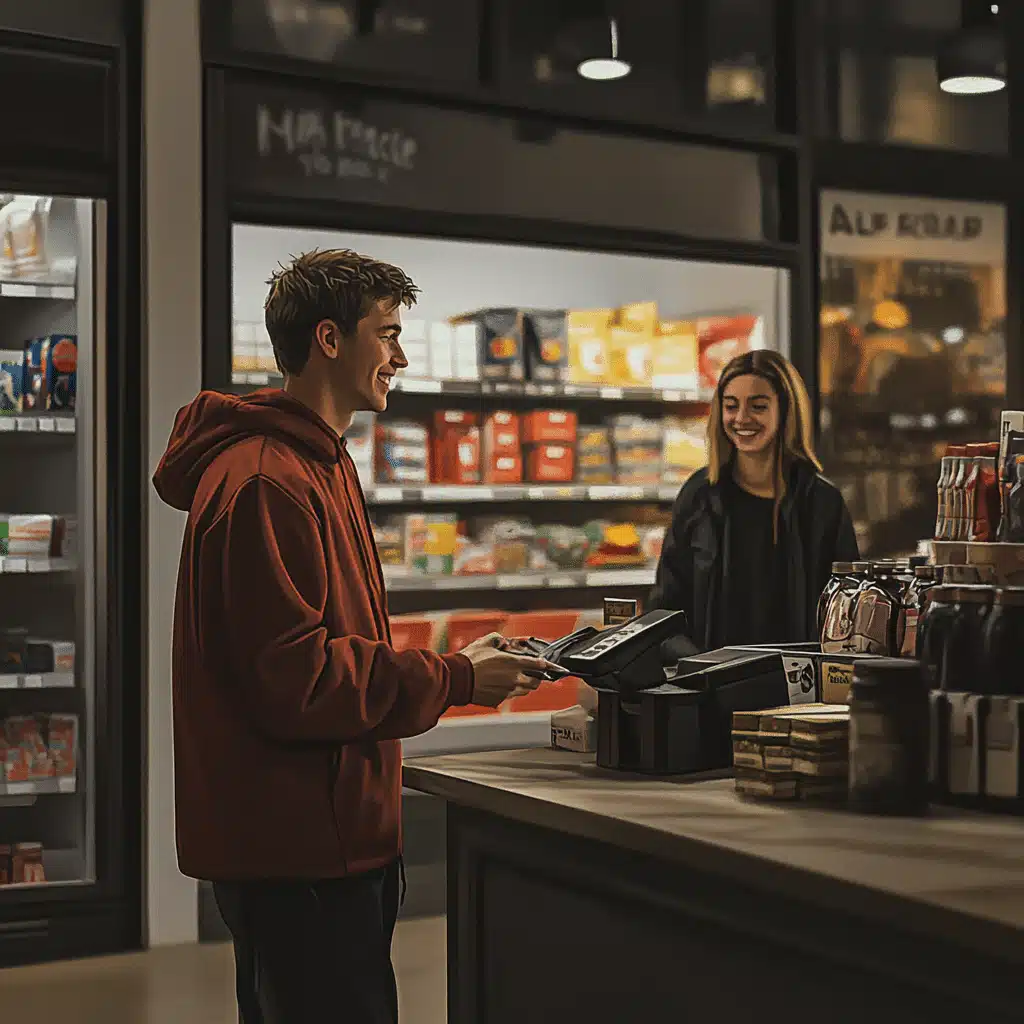



Convenience stores move fast. One customer might have just bought fuel, coffee, and snacks, while another is waiting at the pump to fill up their car, and another employee tries to wait until the rush is over to take payment for their items.
This is why a convenience store POS system must do more than just accept card payments. It has to be able to connect to fuel sales, in-store sales, inventory systems, age-verification systems, fleet-management card systems, loyalty and food sales systems, and reporting, without creating any problems for the store afterward.
Why Convenience Stores Need Specialized Payment Processing
Convenience stores have a different business model from ordinary retail stores. They may offer fuel sales that require pump controls, preauthorizations, fleet cards, and dispenser integrations. Convenience stores also offer in-store sales that include age-restricted products, lotteries, EBT sales, and require the integration of scanners to monitor in-store sales metrics, as well as provide quick-service food sales.
There are many convenience stores in the United States. The Convenience Automotive Suppliers of America (NACS) reports that there are 151,975 convenience stores in the United States. Furthermore, 122,620 of these convenience stores sell motor fuels. NACS also reported that credit and debit card fees from convenience stores reached $21.3 billion in 2025, the highest level ever reported. Convenience store payment processing is vital to the operation and profit of these companies.
Why Generic Retail POS Systems Often Fall Short
While a basic retail POS system might work well for a boutique or small shop, the needs of a c-store are more specialized. A gas station POS system must support pay-at-pump sales, fuel sales, in-store sales, loyalty programs, and more.
In addition, a POS system that does not include features for age verification, tobacco sales, lotteries, fuel, and fleet payments will force the business to rely on manual processes that can create errors and shrinkage.
Who Needs a Convenience Store Merchant Account
Operators of the following types of stores will benefit from establishing a merchant account and POS system:
- Independent convenience stores
- Gas stations
- Unbranded fuel brands
- Convenience store chains with multiple locations
- Convenience stores that sell tobacco products, vape products, alcohol and lottery products
- Convenience stores that also offer prepared food
- Convenience stores that accept fleet cards and EBT
- Those who are in the process of choosing a convenience store POS system
- Those who are analyzing the costs of convenience store merchant accounts
- Convenience stores that are upgrading their POS, payment terminal or fuel pump systems
If fuel, inventory, cashier speed and payment reconciliation all affect your margins, the POS and merchant account should be evaluated together.
Convenience Store POS System and Payment Options Compared
The best setup depends on whether the store sells fuel, needs pump integration, runs foodservice, supports age-restricted items or manages multiple locations.
| POS Or Payment Setup | Best For | Main Strength | Main Tradeoff |
|---|---|---|---|
| Fuel-Integrated POS | Gas stations and c-stores with pumps | Connects fuel, store sales, payment and reconciliation | More specialized and expensive than standard retail POS |
| Retail POS Without Fuel | C-stores without pumps | Simpler setup for inventory, barcode scanning and card payments | Not enough for fuel dispenser control |
| Mobile POS / Handheld Tools | Line-busting, curbside pickup or event sales | Adds flexibility during rush periods | Usually not a replacement for the main c-store POS |
| Merchant Account + POS | Stores wanting payment flexibility | Can support better rate review, reporting and processor fit | Requires underwriting and setup planning |
| All-In-One POS And Processing | Smaller operators wanting one provider | Simpler support and bundled tools | Less flexibility if payment needs change |
| Multi-Location POS Platform | Growing c-store operators | Centralized reporting, pricing and permissions | Higher implementation and training needs |
| Back-Office + POS Integration | Operators focused on inventory and margins | Better pricebook, vendor and reporting control | Requires clean data and staff discipline |
For fuel-selling stores, pump integration is usually the deciding factor. For non-fuel c-stores, the decision may lean more heavily on inventory, age verification, checkout speed, and payment pricing.
Best Convenience Store POS Systems and Payment Solutions Compared
Provider fit depends on whether the store sells fuel, needs forecourt integration, wants payment flexibility or operates multiple locations.
| Provider Or Setup | Best Fit For | Key Strength | Main Tradeoff |
| Payment Nerds | C-stores and gas stations that need merchant account guidance, POS planning and convenience store payment processing support | Strong fit for payment-cost review, POS hardware strategy, fuel and retail payment planning, chargeback controls and Visa Acquirer Monitoring Program (VAMP) monitoring where relevant | More consultative than a plug-and-play retail POS |
| Verifone Commander / C18 | Fuel and convenience retailers needing integrated store and forecourt control | Connects fuel, payments and store operations with c-store-specific POS tools | Best fit when the operator wants a fuel-focused Verifone ecosystem |
| Gilbarco Passport | Fuel retailers needing pump, store and payment integration | Strong fit for forecourt POS, fuel reconciliation, loyalty and c-store workflows | Implementation depends on equipment, partners and site needs |
| NCR Voyix | Larger c-store and fuel operators needing enterprise retail technology | Strong convenience and fuel footprint, multi-location technology and retail operations depth | Can be more complex than a single-store operator needs |
| Petrosoft | C-stores needing POS, back-office and inventory visibility | Strong back-office, pricebook, inventory and reporting focus | POS/payment fit depends on the full configuration |
| Clover | Smaller non-fuel c-stores and retail-heavy operators | Flexible hardware, app marketplace, inventory tools and payment acceptance | Not usually enough for full fuel forecourt control by itself |
| Square | Simple c-stores without fuel or complex restricted-product needs | Easy setup, familiar tools and mobile-friendly payments | Limited fit for fuel, lottery, fleet and more complex c-store operations |
| PDI | Multi-location convenience and petroleum operators | Strong enterprise retail, ERP, loyalty and petroleum ecosystem tools | More advanced than many independent stores need |
Payment Nerds is usually the strongest fit when the operator wants help comparing POS hardware, merchant account structure, payment fees, gateway tools and account stability. Fuel-focused POS providers may be stronger when the main need is deep pump, forecourt and petroleum ecosystem integration.
How VAMP Impacts Convenience Store Payment Processing
Visa’s VAMP is the organization’s combined program for fraud and dispute monitoring. The ratio used for the Visa Acquirer Monitoring Program (VAMP) is the number of fraud reports and non-fraud disputes divided by the number of settled Visa transactions. TC40 is the number of reports for fraud transactions, and TC15 is the number of disputes or chargebacks for Visa.
Since most transactions at convenience stores are from customers who present their cards, stores are automatically exposed to less online fraud. However, if a store accepts online orders or conducts transactions without presenting a card, such as for delivery orders and purchases from their ecommerce store, the Visa Acquirer Monitoring Program (VAMP) will impact the store.
The Visa Acquirer Monitoring Program (VAMP) also includes monitoring for enumeration attacks. Enumeration attacks happen when bots attempt to test various credit cards on a website’s checkout page. The enumeration ratio is the number of suspected attempts to enumerate credit cards divided by the total number of authorization attempts for a store. The VAAI score indicates whether enumeration attacks have occurred on a store’s site. If the score falls within the Standard or Excessive range, the store will be subject to fees.
To comply with VAMP, convenience stores must protect their digital and card-not-present sales channels. All sales channels, including fuel pumps, in-store, mobile applications, online orders, and loyalty programs, must be protected from fraud and disputed transactions.
Choosing a Convenience Store POS System in 2026
First, consider whether the store will sell motor fuels. If so, the POS system should be able to manage fuel pumps, sales reconciliation, fuel sales payments, fleet cards, and pump controls. Otherwise, a general retail POS system may work for the store.
Next, consider in-store needs. Features to consider include barcode scanners, age verification, tobacco sales, lotteries, EBT, food sales, kitchen management, loyalty programs, inventory tracking, vendor management, employee permissions, and store reporting. These features should be included in the best POS system for convenience stores.
Finally, review the payment terms. Consider the price of the equipment, payments for debit and credit card sales, fleet cards, contactless payments, fuel sales, chargebacks, refunds, and the responsibility for complying with the Payment Card Industry (PCI) security standards. A low equipment price may seem like a good deal, but it could end up costing the store more over time.
Understanding Convenience Store Payment Processing Costs
Convenience store payment processing costs include fees for each payment type: card, PIN debit, fleet card, gateway, POS software, hardware, terminal, pump payments, PCI, chargebacks, and batch.
Not all convenience stores have the same transaction mix. A store that sells fuel primarily will have a different cost structure than a retail-focused convenience store or a foodservice-heavy convenience store. Convenience store owners must consider a variety of factors regarding their sales to determine which payment processing company is right for their store.
Common Convenience Store POS Mistakes
The biggest mistake is choosing a POS that can’t manage fuel sales and then trying to add that in later. If fuel is a major part of your convenience store business, it should be part of your POS system from the start.
Another mistake is focusing solely on the hardware cost of a POS system. A cheap POS system may cost less upfront, but could cost more in the long run due to slower sales cycles, poor reporting, limited payment options, or fees.
Convenience Store POS Approval and Setup Checklist
Before selecting a POS and merchant account, gather the following information about your business:
- legal business information
- ownership and bank account details
- store address and background
- fuel brand and unbranded fuel information
- average and maximum fuel sales volume
- average ticket size for fuel and inside sales
- processing statements
- POS, pump and terminal setup
- fuel dispenser and forecourt requirements
- types of tender accepted
- EBT, fleet, lottery and gift card needs
- tobacco, vape and alcohol items
- age verification process
- loyalty program
- back office and inventory system
- multi-location sales and reporting needs
- security and PCI requirements
- chargeback and refund history
A POS and merchant account setup review will help you avoid costly hardware purchases that do not meet your sales needs, do not accept the tender types your customers use, or have terms that do not match your sales volume and type of business.
Key Features of Convenience Store POS Systems
Fuel Pump And Forecourt Integration
Fuel convenience stores need POS systems that integrate with the fuel pump and forecourt area of the store. Features to look for include pump authorization, fuel type controls, dispenser status, pay-at-pump functionality, preauthorization, discount and fuel reconciliation features. If a convenience store is not able to include these features with its POS systems, there will be a disconnect between the store’s payments and its fuel sales. This will present problems for store managers, store owners and bookkeepers.
Fast Checkout And Barcode Scanning
Convenience stores require fast checkout technology. Features should include fast barcode scanners, touchscreens, cash and tender handling, contactless payments and debit and credit cards. Fast checkout technology is important to convenience stores due to the nature of the sales at these locations. If the stores take too long to process sales for customers with small purchases, customers will begin to wait in long lines.
Age Verification And Restricted Product Controls
Many convenience stores offer tobacco products, vape products, alcohol and other restricted products. These stores will require age verification and restricted product controls. These features will ensure that store managers or employees cannot accidentally or intentionally sell restricted products to customers under the legal age of purchase.
Lottery, EBT, Fleet Card And Tender Support
Convenience stores may take different types of payments beyond credit and debit cards. These may include lottery tickets, EBT cards, fleet cards, WEX and Voyager cards, gift cards and house accounts. Many convenience stores take different forms of payment based upon the type of store. For instance, fuel convenience stores may take fleet cards while neighborhood convenience stores may take EBT and PIN debit cards.
Inventory, Pricebook And Vendor Reporting
Convenience store POS systems must handle thousands of SKUs and provide inventory, price book and vendor sales and delivery reports. These reports will provide information regarding the sale of tobacco products, restricted products, high margins and inventory counts. For convenience chains with multiple locations, the POS system should feature control over a price book to ensure all locations have the same prices, promotions and sales reports.
Reconciliation, Fees And Batch Reporting
Convenience store POS systems must manage and report sales from different areas of the store, such as fuel pump sales, inside sales, debit, credit, cash, EBT, fleet cards, lotteries, refunds and chargebacks. Convenience stores pay fees for their sales to the POS companies or the vendors that manage their merchant accounts. Being able to report and monitor these fees will allow convenience store owners to better control their expenses.
FAQs About Convenience Store POS Systems and Payment Processing
Q: What is a convenience store POS system?
A: A convenience store POS system is the software and hardware that convenience stores use to ring up sales, accept payments, manage inventory and restricted products, and reconcile the cash from payments from each store.
Q: What should a gas station POS system include?
A: A gas station POS system should include fuel pump and pay-at-the-pump functions, controls for cashiers, fuel reconciliation, support for fleet cards and payment of fuel via contactless payments, loyalty programs, and inventory as well as reporting and security functions for PCI-compliant payments.
Q: What is convenience store payment processing?
A: Convenience store payment processing involves the merchant account and payment processing setup that allows convenience stores to accept various types of payments, including both in-store and fuel pump payments.
Q: Do convenience stores need a special merchant account?
A: A merchant account for convenience stores should understand the intricacies of selling fuel, taking high volumes of transactions, accepting mostly debit cards, selling age-restricted products, and managing chargebacks for fuel purchases. Convenience stores that also sell fuel will need a more specialized merchant account than those that do not.
Q: What is the best POS system for a convenience store?
A: The best POS system for convenience stores will depend on whether the convenience store sells fuel, how many locations they operate, and the types of payments they should accept. Some of the best POS systems for convenience stores include Verifone, Gilbarco, NCR Voyix, Petrosoft, Clover, and Payment Nerds.
Q: Can convenience stores accept fleet cards?
A: Convenience stores that also sell fuel can accept fleet cards, but only if the POS and payment processing company support these payments. The store will need to ensure that the convenience store and gas station POS system can accept these payments from fleets before implementation.
Q: How can convenience stores reduce credit and debit card processing costs?
A: Convenience stores can review how they route their debit cards, their interchange fees, fuel sales, inside sales, batch sizes, the terms of their payment equipment, and the cost of the payment processing company. The cheapest advertised rate will not necessarily be the best rate for convenience stores.
Q: Does the Visa Acquirer Monitoring Program (VAMP) affect convenience stores?
A: The Visa Acquirer Monitoring Program can impact convenience stores that have higher instances of fraud, chargebacks, or contactless payments. Convenience stores with ecommerce websites or applications that manage online orders must monitor these reports to ensure compliance with the terms of the Visa Acquirer Monitoring Program.
Q: Can Payment Nerds help convenience stores and gas stations compare convenience store POS systems?
A: Yes, Payment Nerds will assist convenience stores in comparing the different convenience store POS systems, convenience store payment processing companies, merchant account providers, fuel pump POS and payment systems, POS hardware companies, and the different chargeback and payment cost providers.
Conclusion
Convenience stores and gas stations need POS and payment systems built with features tailored to their needs. A system that works well for retail stores may not be ideal for convenience stores with their pumps, sales, and fees.
Payment Nerds can help convenience stores compare available POS systems, payment processing companies, merchant account terms, POS hardware, and reporting. The goal is to find the right system for convenience stores that keeps the checkout experience fast, payment systems reliable, and sales and revenue data clear for store owners who want to grow their convenience stores.
Sources
- NACS. “2026 U.S. Convenience Store Count.” Accessed June 2026.
- NACS. “U.S. Convenience In-Store Sales Top $340 Billion.” Accessed June 2026.
- Verifone. “Commander C18 Point of Sale.” Accessed June 2026.
- Verifone. “Convenience Store & Petroleum POS Solutions.” Accessed June 2026.
- Verifone. “Convenience Store & Gas Station Payment Processing.” Accessed June 2026.
- Invenco by GVR. “Passport POS.” Accessed June 2026.
- Gilbarco Veeder-Root. “Passport Suite C-Store Point of Sale.” Accessed June 2026.
- NCR Voyix. “Convenience, Fuel & Retail.” Accessed June 2026.
- Clover Docs. “Manage Age-Restricted Items.” Accessed June 2026.
- Petrosoft. “The Ultimate Guide to Convenience Store POS Systems: 2026 Edition.” Accessed June 2026.
- Visa. “Visa Acquirer Monitoring Program Fact Sheet.” Accessed June 2026.
- PCI Security Standards Council. “Merchant Resources.” Accessed June 2026.